Free guide / Shiver
14-Day Cold Shower Plan for Beginners, Plus What the Evidence Shows
Published
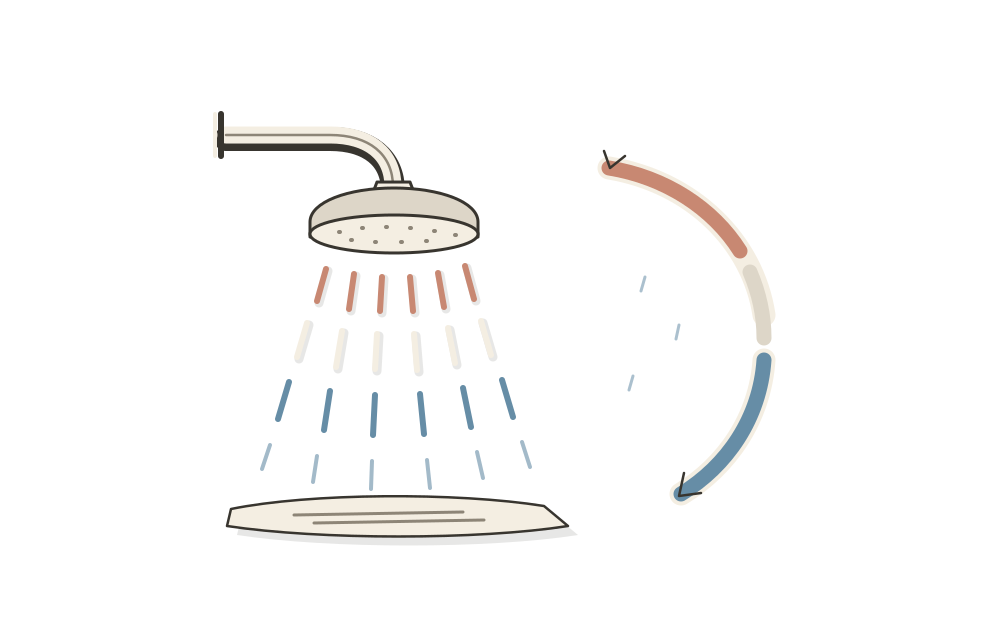
The easiest way into cold showers is to change only the last minute of a shower you already like. Wash warm like normal, step down to cool for 30 seconds, then finish cold. You start at 15 seconds of cold on day 1 and build to 90 seconds on day 14. Every day's numbers are in the table below.
The 14-day plan, day by day
Every day has the same warm and cool phases. Only the cold finish grows, in small steps of 5 to 10 seconds.
| Day | Warm | Cool | Cold | Total |
|---|---|---|---|---|
| 1 | 3 min | 30 s | 15 s | 3 min 45 s |
| 2 | 3 min | 30 s | 20 s | 3 min 50 s |
| 3 | 3 min | 30 s | 25 s | 3 min 55 s |
| 4 | 3 min | 30 s | 30 s | 4 min |
| 5 | 3 min | 30 s | 40 s | 4 min 10 s |
| 6 | 3 min | 30 s | 45 s | 4 min 15 s |
| 7 | 3 min | 30 s | 50 s | 4 min 20 s |
| 8 | 3 min | 30 s | 55 s | 4 min 25 s |
| 9 | 3 min | 30 s | 60 s | 4 min 30 s |
| 10 | 3 min | 30 s | 65 s | 4 min 35 s |
| 11 | 3 min | 30 s | 75 s | 4 min 45 s |
| 12 | 3 min | 30 s | 80 s | 4 min 50 s |
| 13 | 3 min | 30 s | 85 s | 4 min 55 s |
| 14 | 3 min | 30 s | 90 s | 5 min |
The cool phase is the ramp. Turn the dial about halfway toward cold for 30 seconds, then all the way to the coldest your tap goes. Those 30 seconds are what make the final step manageable.
How to do one session
- Warm, 3 minutes. Wash and rinse as usual. Do everything you need to do before the cold starts, so the cold part is only about standing there.
- Cool, 30 seconds. Turn the temperature down until it feels clearly cooler but not yet sharp. Keep the water on your back and shoulders.
- Cold, the day's number. Turn to the coldest setting. Let the water run over your upper back and shoulders first, then your chest. Your hands and face can come in last.
- Slow your breathing. The first few seconds are the hardest. A long, slow exhale through your mouth, then steady breaths in through your nose, takes the edge off the gasp.
- Count it out. Use a clock, a phone across the room, or your own steady counting. Guessing makes short seconds feel long and long seconds feel impossible.
- Turn off and dry off. Towel down briskly and get dressed while your skin is still warm and tingling.
How to progress, and what to do on a hard day
- Follow the table in order. The steps are deliberately small: the biggest jumps are 10 seconds, and most days add 5.
- Repeat a day when the last one felt like a stretch. Doing day 6 twice is better than rushing to day 7 and quitting. The plan is a ladder, not a deadline.
- Missed a day or two? Carry on from the day you missed. After a week or more away, go back a few days in the table and build up again from there.
- Keep the warm part warm. You are adding a short cold finish, not trading comfort for discipline. A shower you enjoy is a shower you will keep taking.
- Pick a fixed trigger. Step in, wash, and the cold finish is simply the last thing you do before turning off the water. Tying it to something you already do every day makes it automatic faster than willpower does.
- After day 14, stay at 60 to 90 seconds as your normal finish, or repeat the weeks you enjoyed. There is nothing special about longer.
What cold showers can and can't do
Cold showers have a lot of big claims attached to them online. The evidence is smaller, younger and more mixed than the videos suggest. Here is what it actually shows.
What your body does in the first seconds
Sudden cold skin triggers the cold shock response: an involuntary gasp, fast breathing, a racing heart and a jump in stress hormones. Tipton et al. (Experimental Physiology, 2017) review how the body responds to cold water, and the randomized trial discussed below notes that the largest physiological response comes in the first 30 seconds.
The same response fades with repeat exposure. A systematic review and meta-analysis of cold shock habituation (Barwood et al., Journal of Thermal Biology, 2024) found that habituation appears after about four immersions. That is why the first week feels so different from the second, and why a gradual ramp makes sense.
Fewer sick days, but not fewer illnesses
The best study on cold showers specifically is a randomized trial: Buijze et al., PLoS One, 2016. It assigned 3,018 healthy adults to a regular shower or to finishing with 30, 60 or 90 seconds of cold for 30 days, then followed them for 90 days in all.
- The cold-shower groups reported 29% fewer days of sickness absence from work than the control group.
- They did not report fewer days of feeling ill. Illness days were not meaningfully different.
- 30, 60 and 90 seconds performed the same. More cold did not do more.
- The most commonly reported benefit was a feeling of more energy, which many participants compared to caffeine.
- About 64% were still taking cold showers by the end.
- The most common downside was feeling cold for a while afterward, reported by a minority of participants.
The authors are open about the limits. Everything was self-reported, nobody could be blinded to which group they were in, and participants were unusually healthy and active. They write that the data cannot say whether the effect was causal. A fair reading: people who finish cold seem to push on through and show up, but they do not appear to catch fewer bugs.
Alertness and mood
The energy lift is the most consistent thing people report, and it fits the physiology: cold exposure raises noradrenaline and stress hormones, which is part of what makes you feel sharp. The trial above found a small improvement in mental quality of life at 30 days that the authors judged too small to be clinically relevant, and no difference by 90 days. Treat the lift as a pleasant, short-lived effect, not a treatment for low mood.
Metabolism and brown fat
Studies of experienced winter swimmers show interesting changes in how their bodies produce heat, for example Søberg et al., Cell Reports Medicine, 2021. That was a small study of men immersing in cold water two to three times a week. It says little about a 90-second finish in a bathroom, and it does not show that cold showers cause weight loss.
Where the evidence stops
- Immune system: the shower trial found fewer sick days, not fewer illnesses, and its authors note that short-term hormone changes from cold produce minimal immune effects. A stronger immune system is not shown.
- Fat loss: not shown at shower doses.
- Depression or anxiety: not shown. The trial's anxiety measure did not differ between groups.
- Longer is better: not shown. In the trial, 90 seconds did no better than 30.
- Long-term outcomes: the longest trial follow-up was about three months, and most of the research uses whole-body immersion in much colder water than a tap delivers.
What stays after you strip away the hype is modest and real: a sharp jolt of alertness, a small act of choosing something hard on purpose, a habit that is easy to count, and a possible sense of showing up more reliably. That is a perfectly good reason to do it.
Sources
- Buijze GA et al. The Effect of Cold Showering on Health and Work: A Randomized Controlled Trial. PLoS One, 2016.
- Tipton MJ et al. Cold water immersion: kill or cure? Experimental Physiology, 2017.
- Barwood MJ et al. Habituation of the cold shock response: A systematic review and meta-analysis. Journal of Thermal Biology, 2024.
- Søberg S et al. Altered brown fat thermoregulation and enhanced cold-induced thermogenesis in young, healthy, winter-swimming men. Cell Reports Medicine, 2021.
Shiver
Take it further with Shiver.
Shiver runs the warm, cool and cold phases on a timer for you and keeps a before-and-after mood log so you can see how the habit feels for you.
Meet Shiver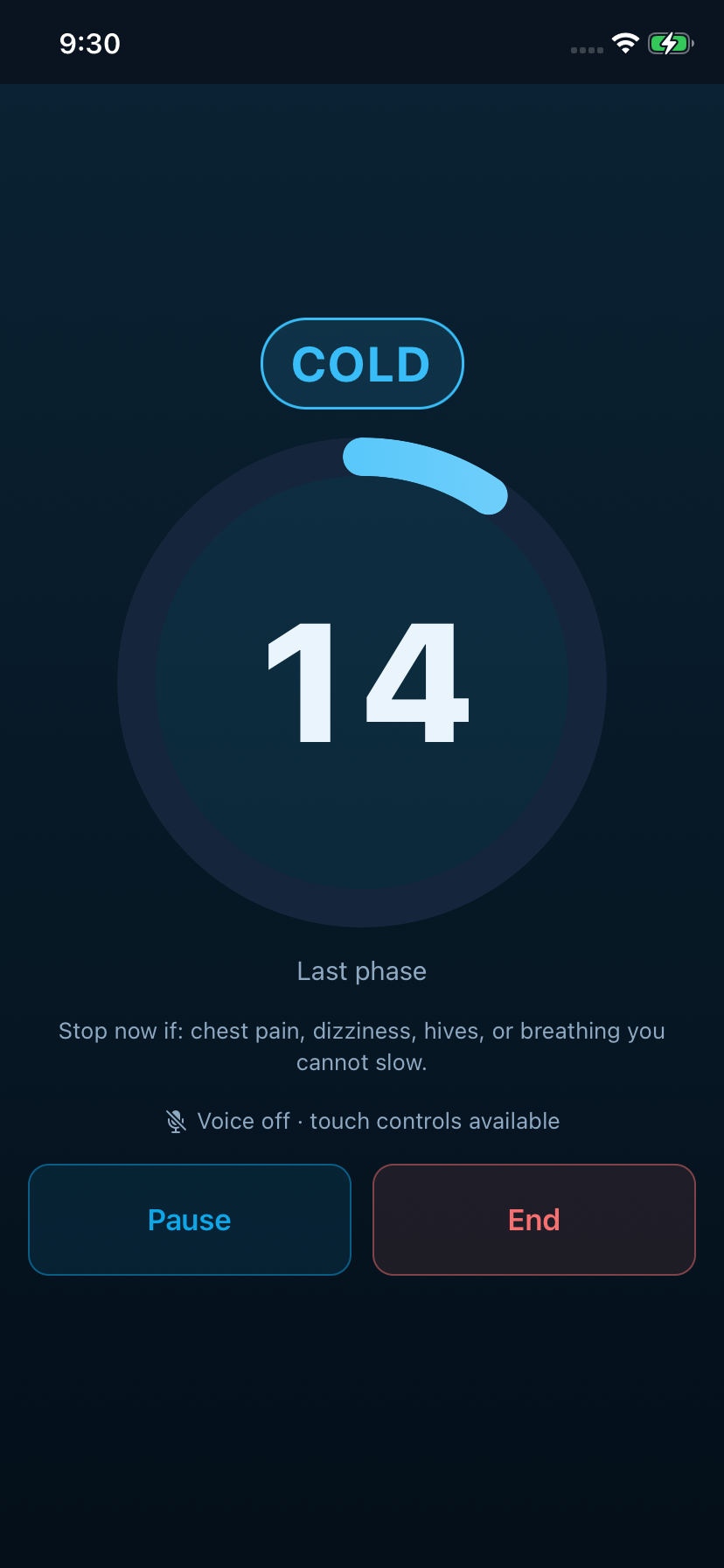
Actual timer view · not a recommended cold-exposure duration.
Check with a doctor first if you have heart or circulation conditions. Stop if you feel unwell.