Free guide / Duskmere
How to Remember Your Dreams: A 7-Morning Plan

Published
Most people who say they never dream are really saying they never remember. The fix is smaller than it sounds: capture whatever is in your head in the first minute after waking, every morning, for a week. Here is the routine, a seven-morning plan, and what to write when you wake up with almost nothing.
Why dreams fade so fast
A dream you remember at 6:40 a.m. is often gone by 7:15. The first few minutes after waking are the window. Moving around, checking the time, reading messages and starting to plan the day all push the dream out, and the images tend to go the way a whiteboard does when it's left out in the rain.
Two findings from dream research are worth knowing, because they shape the routine below:
- Writing beats remembering. A 2015 review in Consciousness and Cognition (Aspy, Delfabbro and Proeve) found that keeping a dream logbook turns up more dreams than asking people to recall them after the fact.
- It helps most if you start low. In a two-week diary study, Schredl (2002) found that recall rose in people who remembered little or a moderate amount and fell in people who already remembered a lot. If you already wake with several dreams most mornings, a diary won't add much. If you wake with almost nothing, it is the best tool you have.
The one rule: write before you do anything else. Don't check your phone, don't get up, don't start thinking about the day. A few words is a full success.
The morning capture routine
- Stay still when you wake. Keep your eyes closed and your body where it is for a few seconds. Don't reach for the clock.
- Ask what you were just thinking. Whatever your mind was doing a moment ago is the end of a dream. Hold onto it, even if it's a single image or a feeling.
- Follow the thread backward. From that last image, ask what came just before it. Dreams often unspool in reverse, and one scrap frequently pulls up the scene behind it.
- Write keywords first. Before any sentences, put down five or six words: people, places, objects, an emotion. These are anchors you can expand from.
- Expand while it's still fresh. Turn the keywords into a few lines in the order things happened, present tense if that helps ("I'm in my old school, the stairs go sideways").
- Add a title and a mood. Two or three words for the dream, and one word for how it felt. These make old entries easy to scan later.
- If there's nothing, write that. "Nothing, groggy, alarm woke me mid-sleep" counts. It keeps the habit alive, and sometimes a stray image turns up a few seconds after you start writing.
Keep your notebook or phone within arm's reach of the bed, already open to a blank page, so the capture takes no setup.
Your first seven mornings
This plan builds the habit in small steps. Each morning has one job. Don't skip ahead, and don't judge any single day; judge the week.
| Morning | Focus | What to do |
|---|---|---|
| 1 | Set up | Put the notebook or phone by the bed. Tonight, tell yourself plainly: "I will remember my dreams." Tomorrow, write whatever you have, even one word. |
| 2 | Stay still | Practice the first ten seconds: eyes closed, no movement, no clock. Then write keywords. |
| 3 | Go backward | Use the last image as a handle and trace what came before it. Aim for three keywords more than yesterday. |
| 4 | Expand | Turn your keywords into a few lines in the order things happened. Don't polish anything. |
| 5 | Feelings | Add a mood word and a title. Note how you felt in the dream, not only what you saw. |
| 6 | Fragments count | Write every scrap: one object, a sentence of dialogue, a color. Resist the urge to wait for a whole story. |
| 7 | Read it back | Read all seven entries. Circle anything that appeared twice. That's the start of your pattern list. |
Expect it to be uneven. One morning may hand you three vivid scenes and the next nothing at all. That's normal: the benefit shows up across a run of mornings, not on any single one. After the first week, keep going for a second before you decide whether it's working.
What to write down
You don't need good prose. Capture whatever comes, in whatever order it arrives. These prompts help when you're not sure what counts:
- Where. The place, and whether it was somewhere you know or a mashup of places.
- Who. Anyone present, including people you haven't thought about in years or people who didn't look like themselves.
- What happened. Even a single action: running, searching, falling, being late.
- What felt off. Anything that couldn't happen awake, however normal it seemed at the time.
- Dialogue and text. Any exact words, signs or numbers you remember.
- The feeling. Fear, calm, embarrassment, excitement. Emotion is often the part that lasts longest.
- The ending. How it ended or what woke you.
Quick examples of the right level of detail:
- Keywords only: grandmother's kitchen, no door, orange light, late for something
- Short entry: In my grandmother's kitchen but the door had vanished. Orange light. I knew I was late and couldn't remember for what. Woke up anxious.
Tips that make it stick
- Use a gentle wake-up. A harsh alarm wipes the scene out. If you can, wake naturally or use a soft sound.
- Keep the phone face down and the room quiet until you've written. Checking messages is the quickest way to start the day's thinking and push the dream out.
- Move as little as you can before you capture. Getting up shifts you into morning thinking, so write first.
- Write at night too. If you wake at 3 a.m. with a dream, jot a few keywords; it may not be there by morning.
- Trust fragments. A single image written down can pull the scene around it back as you write.
- Don't skip a bad day. A short "nothing" entry protects the habit better than a missed morning.
- Be patient with yourself. Plan on two weeks of honest effort before deciding whether it works for you.
A first taste of dream signs
A dream sign is something that keeps appearing in your own dreams and would be an obvious tell, if you noticed it, that you aren't awake. They're personal: one person's dreams are full of impossible staircases, another's keep returning to a childhood house or a phone that won't dial.
They tend to fall into a few loose groups:
- The world does something impossible: flying, breathing underwater, walking through walls.
- You or your body is subtly wrong: extra fingers, no reflection, clothes from another decade.
- The plot loops: being back at a school you finished years ago, taking a test you never studied for.
You can't find these in dreams you don't remember, which is why the capture habit comes first. After a week or two of entries, reread them and ask three questions:
- What keeps showing up: the same place, person or object?
- What happened that couldn't happen awake, however normal it felt?
- Is there a recurring mood: anxious, searching, crowded?
Pick the one that appears most often or hits hardest, and just notice it for a week. One specific sign you recognize as your own is worth more than a long list borrowed from someone else's dreams.
Where recall can lead
Good recall is the base for everything else people do with their dreams, including learning to notice that you're dreaming while it happens. In a 2020 prospective study of lucid dream induction, the International Lucid Dream Induction Study, which began with a baseline logbook week before a practice week, dream recall was a predictor of success. Recall is also the habit most under your control, so it's the right place to begin, and a perfectly good place to stay if all you want is to remember more of what your sleeping mind does.
Sources
- Aspy, D. J., Delfabbro, P. & Proeve, M. (2015). Is dream recall underestimated by retrospective measures and enhanced by keeping a logbook? A review. Consciousness and Cognition, 33, 364–374.
- Schredl, M. (2002). Questionnaires and diaries as research instruments in dream research: methodological issues. Dreaming, 12(1), 17–26.
- Aspy, D. J. (2020). Findings from the International Lucid Dream Induction Study. Frontiers in Psychology, 11:1746.
Duskmere
Take it further with Duskmere.
Duskmere keeps your dream journal with a keywords-only mode for half-asleep mornings and turns your tags into a ranked list of your recurring dream signs.
Meet Duskmere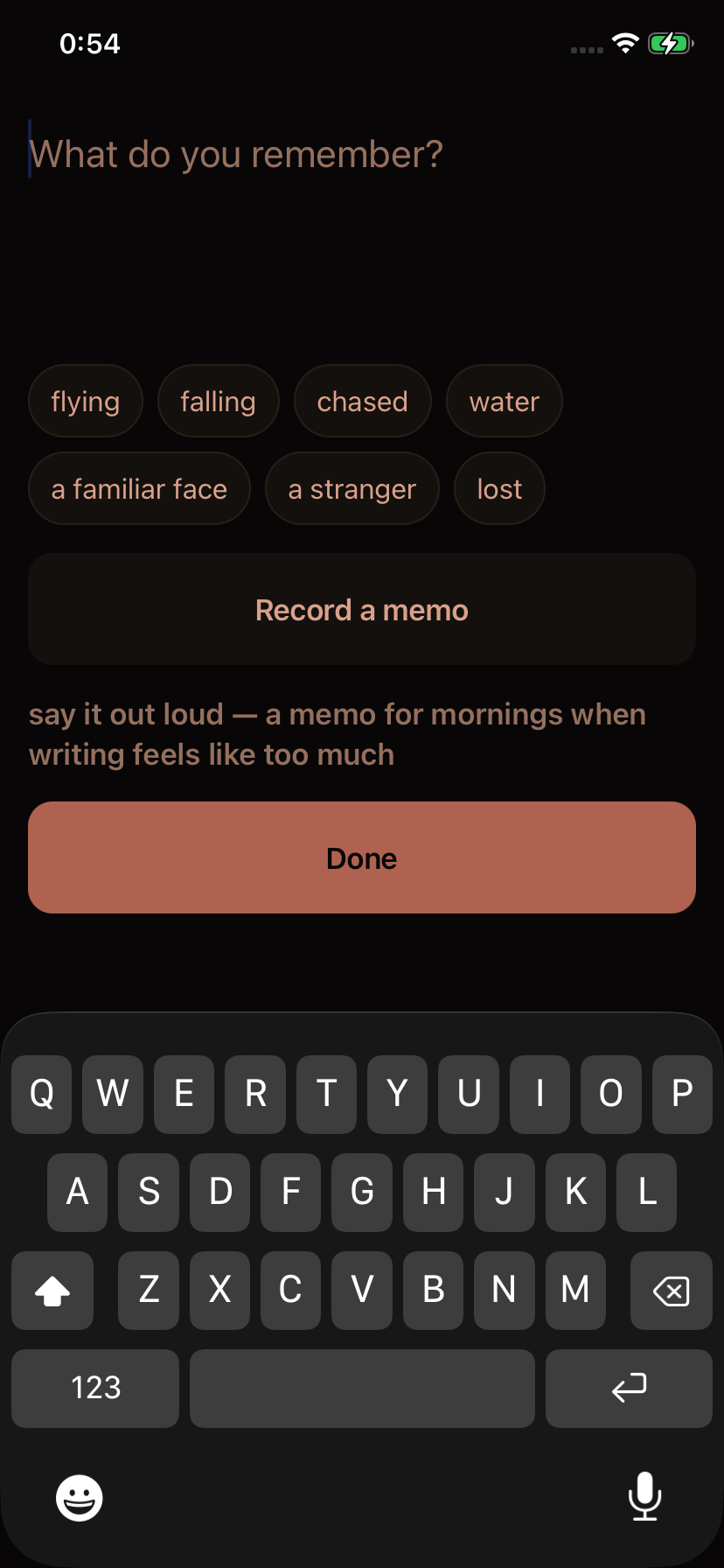
Actual app capture · a quiet place to catch a dream.