Free guide / Penumbra
How to Start Shadow Work: A 15-Minute Guide With Prompts

Published
Shadow work is the practice of noticing the parts of yourself you usually keep out of sight, then writing about them honestly. You can start today with a pen, fifteen minutes and one good question.
What shadow work is
The psychologist Carl Jung used the word shadow for the side of your personality you don't show or even admit to yourself: the traits, wants and reactions you learned to tuck away in order to fit in (APA Dictionary of Psychology).
Hidden does not mean bad. A child told that anger is rude learns to hide anger. A child praised for being easy learns to hide needs. Years later the hidden material still shows up, just sideways:
- A flash of irritation at someone that is out of proportion to what they did.
- Envy of a person who does something you quietly want to do.
- A habit of seeming fine when you aren't.
- A rule you follow without remembering who made it.
Shadow work means turning toward those moments with curiosity instead of judgment. The goal is understanding, not fixing yourself.
Why people do it by writing
Writing slows a reaction down enough to look at it. A thought on the page can't change shape the way it does in your head, and a page doesn't interrupt, advise or react. Researchers have studied writing about stressful or emotional experiences for decades; a widely cited review of the evidence is Baikie and Wilhelm (2005).
Privacy matters here. You will write more honestly if you know nobody will read it, so decide before you start where the pages live and who can see them.
Run a 15-minute session
You need a notebook or a blank note, a timer and a place where you won't be interrupted. Do one prompt a day for a week, then once or twice a week.
- Settle (2 minutes). Sit down, put your phone on silent and take a few slow breaths. Write today's date and one line on how you feel right now. Plain words are fine: "tired", "wired", "okay".
- Pick one prompt (1 minute). Choose a single question from the list below. If one makes your stomach tighten slightly, that is usually a good sign. If it makes you want to close the notebook completely, pick a gentler one.
- Write without editing (8 minutes). Set the timer and keep your pen moving. Don't fix spelling, don't be fair to anyone, don't aim for insight. If you get stuck, write the prompt again and finish the sentence a different way.
- Re-read once (2 minutes). Underline the sentence that surprised you most, or the one you almost didn't write.
- Close it (2 minutes). Write one kind line to yourself, then stand up, drink some water and do something ordinary. Ending on purpose matters as much as starting.
Rule of thumb: stay with the feeling, not the story. "I felt dismissed and small" is more useful than a full account of what your coworker did.
Seven prompts to start with
These are first-week questions from the free seven-day journey in Penumbra. Take one per session, and don't write all seven in a sitting.
- Think of a feeling you tend to hide from other people — maybe anger, neediness, or pride. When did you first learn it was safer to keep it out of sight?
- Finish this sentence a few times over: "People would be surprised to know that I..."
- Picture how an acquaintance would describe you. Now describe the version of yourself only you know at 2 a.m. Where do the two most disagree?
- Bring to mind someone who genuinely gets on your nerves. What exact quality in them bothers you most?
- Think of someone you quietly envy. Strip away the judgment: what do they have or do that you want for yourself?
- Growing up, which feelings were allowed to be expressed out loud in your home — and which ones got you shut down, teased, or ignored?
- Finish this without judging the answer: "The part of me I least want to look at is..."
How the prompts work
They are ordered on purpose. The first two ask what you hide. The next two look at how you present and what irritates you in others, which is often a reflection of something you disown in yourself, a pattern Jung called projection. The last three go to envy, family rules and resistance. If you do them in this order across a week, each question has something to build on.
What to do after you write
Shadow work doesn't end when the timer does. A few small habits make the pages useful.
Look for the pattern, not the verdict
After a few sessions, read back and ask three questions: which feelings come up again? Which people trigger them? Which rules show up ("don't be needy", "never be the problem")? Write the answers at the top of a new page.
Turn one insight into one small action
If you notice you always say yes before thinking, the experiment is not "stop people-pleasing". It is "this week, take one day to answer a request with 'let me get back to you.'" Keep it small enough that it can't go badly.
Treat strong feelings as information
Some sessions leave you sad, angry or tender. That is normal. Move your body, talk to a friend, take a walk and give it a day before deciding what it means.
Don't confront anyone with your findings
Realizing that a parent shaped your rules, or that a colleague mirrors something in you, is for you to hold. You don't have to announce it or act on it.
How to keep going
- Make it small and regular. Fifteen minutes weekly beats two hours once a month. Attach it to something fixed, like Sunday morning coffee.
- Expect resistance. Around the middle of any run of sessions people start avoiding the notebook, rushing past a question or "forgetting". Write about the avoidance itself. It is often the most honest page of the week.
- Use a pace you can sustain. One prompt a day for a week, then once or twice a week, with a pause now and then to read everything back.
- Revisit old answers. Answer the same question again after a month and compare. What changed is more interesting than either answer alone.
- Skip freely. Any question can be passed over. Choosing which ones you skip tells you something too.
- Balance the heavy with the light. After a hard session, note one moment from the day that felt good. Shadow work is about the whole of you, not only the difficult parts.
Quick answers
Do I need a therapist to start?
No. Journaling can be done alone.
How long until I notice anything?
Many people notice something in the first week, often a new awareness of when they hide a feeling. Deeper shifts are slower and not guaranteed, so judge it by whether you understand yourself a bit better, not by a deadline.
What if I can't think of anything to write?
Write "I can't think of anything" and then finish the sentence "because...". Blank pages usually have a reason.
Sources
- APA Dictionary of Psychology: shadow
- Baikie, K. A. & Wilhelm, K. (2005). Emotional and physical health benefits of expressive writing. Advances in Psychiatric Treatment, 11(5), 338-346.
Penumbra
Take it further with Penumbra.
Penumbra turns these prompts into a guided seven-day journey with a private, on-device journal, a trigger log and Face ID lock.
Meet Penumbra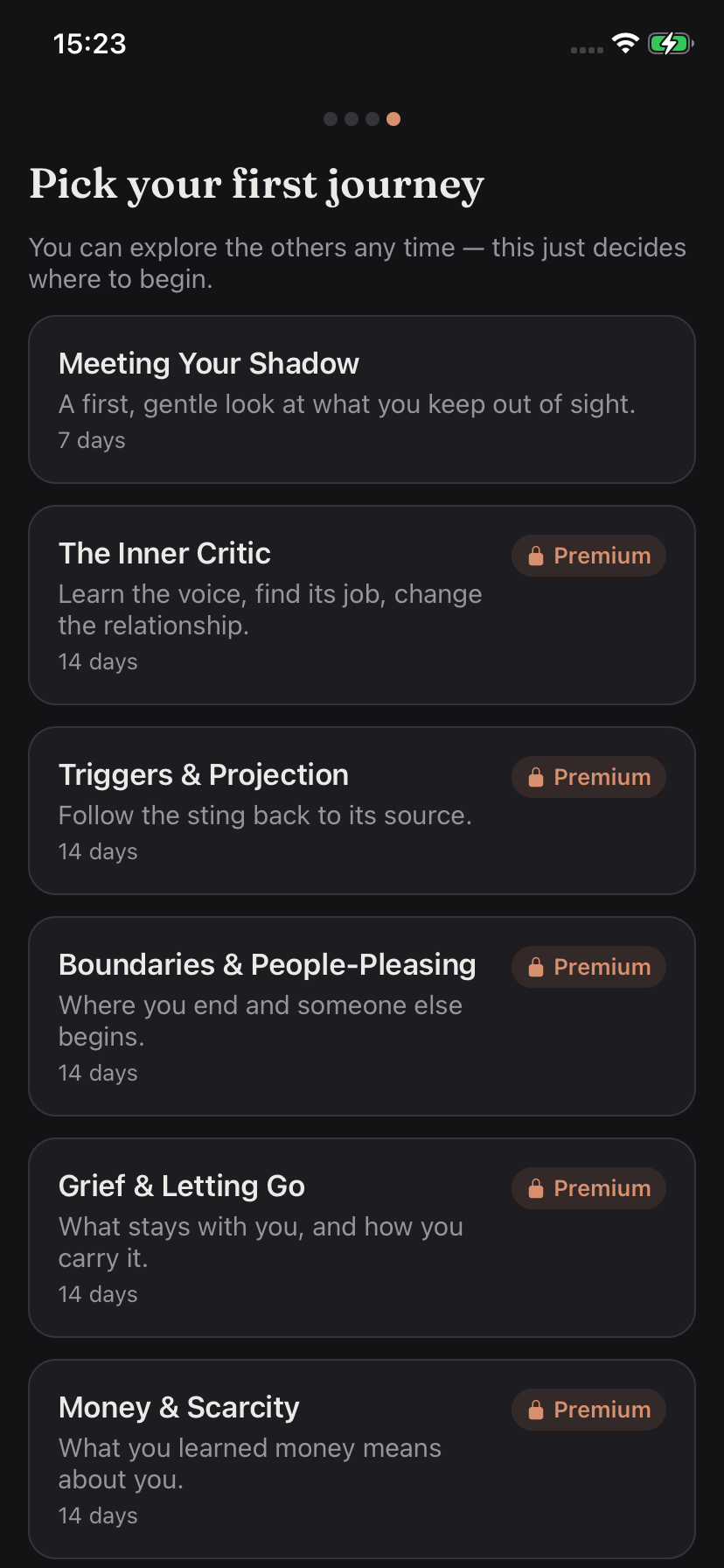
Actual app screen · choose a guided journey.
If you are in crisis or thinking about harming yourself, call or text 988 in the US, or contact local emergency or crisis services elsewhere. Stop writing if it feels overwhelming, and consider talking with a licensed professional.