Free tool / Voxwarm
Free Five-Minute Vocal Warm-Up With Piano
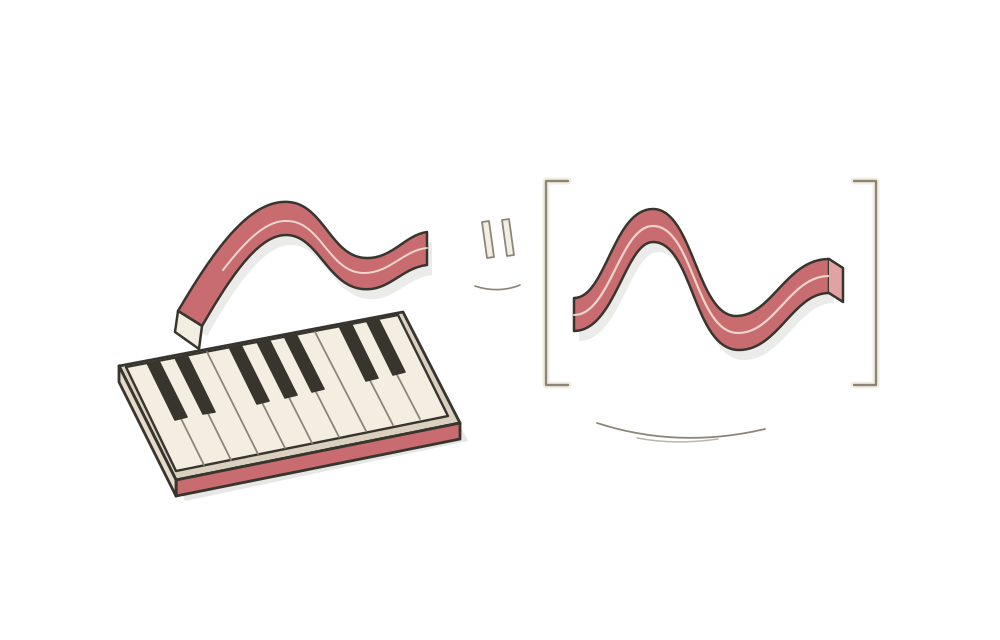
Published
Five minutes, six exercises, one piano. Pick your voice range, press Start, and the warm-up plays each pattern for you to sing back: a slow breath, a five-note scale, a triad, an octave siren, a lip trill and a hum.
Five-minute singer warm-up
The routine, in order
| # | Exercise | Sing | Shape |
|---|---|---|---|
| 1 | Deep belly breath | Silent | In 4 seconds, hold 2, out 6 |
| 2 | Five-note scale | ah | 1-2-3-4-5-4-3-2-1 |
| 3 | Triad | ah | 1-3-5-3-1 |
| 4 | Octave siren | oo | One smooth glide up an octave |
| 5 | Lip trill five-note | brr | 1-2-3-4-5-4-3-2-1 |
| 6 | Hum on a triad | hmm | 1-3-5-3-1 |
How the warm-up plays
- Pick the voice type closest to yours. When in doubt, pick Medium.
- Press Start. The breath comes first: follow the on-screen cue for 12 seconds.
- For each pattern the piano plays the phrase, three clicks count you in, then it is your turn to sing it back at the same pace.
- The same pattern then repeats from a higher starting note and comes back down, so you warm up across your range. Every note stays at least two semitones inside the range you chose, so nothing starts on your highest or lowest note.
- Pause stops the sound; Resume restarts the current step. Next skips ahead.
Each pattern gets an equal share of the five minutes, so the session comes to roughly 4 to 5 minutes whichever range you pick.
Each exercise and how to do it well
1. Deep belly breath
Breathe in for 4 seconds, hold for 2, breathe out for 6. Let the breath drop low, so your lower ribs and belly widen, and keep your shoulders still. A longer exhale than inhale teaches you to spend air slowly, which is what every sustained note needs. Keep the hold gentle: nothing is clamped, your throat stays open.
2. Five-note scale on "ah"
The first five notes of a major scale, up and back down: 1-2-3-4-5-4-3-2-1. It is a short, singable shape that wakes up the whole voice before anything harder.
- Sing a light "ah" with a loose, dropped jaw, as if you were about to yawn.
- Keep the volume even on the way down. Pitch sags when the sound trails off.
- Listen first. Finish the piano phrase in your head, then sing.
3. Triad on "ah" (1-3-5-3-1)
Root, third, fifth, then back. Leaps are the basic shape of most melodies, so this builds a clean, connected sound across a skip instead of a step.
- Aim straight for each note. Do not scoop up into it or punch it.
- Think of one long line with the notes as stops along it.
4. Octave siren on "oo"
A single continuous glide from the bottom note up an octave. It smooths out the break between chest voice and head voice.
- Make no steps: slide like a siren, not a staircase.
- Keep the "oo" rounded and the volume light. If the top feels like a reach, stop below it and let the glide shrink.
- If your voice flips at the break, let it flip. Smooth sliding is the aim.
5. Lip trill on "brr"
The same five-note shape as exercise 2, but you let your lips flutter on "brr" the whole way through. It keeps the airflow steady and releases tension in the lips and jaw while still moving through pitch.
- Loosen your lips, rest a finger on each cheek if they will not flutter, and push a steady, unforced stream of air.
- If the trill keeps stopping, use a little less air and a little more patience, or slow it down.
6. Hum on a triad ("hmm")
The 1-3-5-3-1 shape with your lips closed. A gentle, closed-mouth exercise that builds forward resonance without much vocal effort.
- Keep your teeth slightly apart and your tongue resting low.
- You should feel a light buzz around your lips and nose. If it tickles, you are in the right place.
Pick today's range, not your best day's. The warm-up never asks for your lowest or highest notes. If a note feels like a reach, drop to the Low or Medium setting or just skip that round with Next.
Habits that help
- Drink water through the day, not just before you sing. The NIDCD lists hydration and regular voice rest among its healthy habits for taking care of your voice.
- Avoid singing or speaking when your voice is hoarse or tired, and rest it when you are sick, per the same source.
- Breathe low and easy before you sing, which is what the opening belly breath rehearses.
- Stay out of the extremes of your range when warming up. That is why every pattern here starts and ends well inside the range you chose.
Source
- Taking Care of Your Voice, National Institute on Deafness and Other Communication Disorders (NIH).
Voxwarm
Take it further with Voxwarm.
Voxwarm adds call-and-response sessions that listen through your microphone, score each note against the piano, and fit the exercises to your measured range.
Meet Voxwarm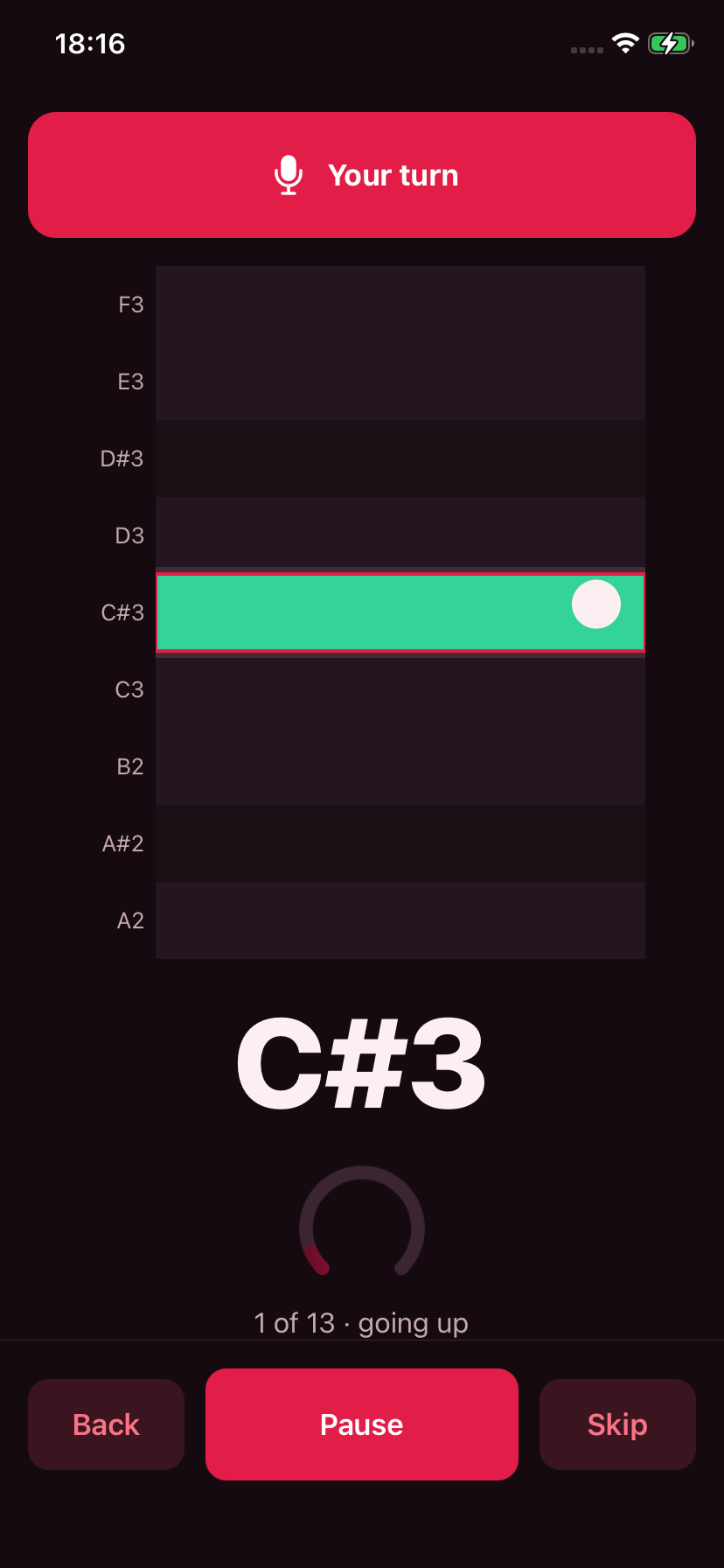
Actual app UI · demonstration pitch, not a measured user result.
Stop if singing hurts, your voice turns hoarse, or you feel lightheaded during the breathing, and rest your voice instead.