Free guide / Posture Coaching
A 5-Minute Desk Stretch Routine
Published
Eight moves, about five minutes, no equipment beyond a chair and a doorway. Work through the list top to bottom once or twice a day: five seated moves, two standing and one you can do either way. Count breaths or glance at the clock if you like; the durations below are a guide, not a stopwatch.
The short version: chin tucks, shoulder rolls, neck stretch, cat-cow, seated twist, doorway chest opener, shoulder blade squeezes, standing hip flexor stretch. Slow and easy, never forced.
The 5-minute routine
Do the first five in your chair, then stand for the last three. Total hold time is about 5 minutes and 20 seconds with natural pauses between moves, so treat it as "about five".
-
Chin tucks — about 25 seconds
Sit tall with your eyes level with the horizon. Gently draw your chin straight back, as if making a double chin, without tipping your head down. Hold for about 10 seconds and breathe, then release slowly to neutral.
Form cue: the motion is a slide backward, not a nod. Keep your jaw loose.
-
Shoulder rolls — about 30 seconds
Roll both shoulders slowly backward in big circles for about 15 seconds, then reverse and roll forward for another 15.
Form cue: make the circles as large and slow as you can. Let your arms hang heavy rather than lifting them.
-
Upper trap stretch — about 45 seconds
Sit tall and drop one ear toward the same-side shoulder. Hold for about 20 seconds, return upright, then repeat on the other side.
Form cue: keep both shoulders low and level. If one creeps up toward your ear, you have gone too far.
-
Seated cat-cow — about 40 seconds
Put your hands on your knees. Arch your back and look up (cow), then round your spine and tuck your chin (cat). Alternate slowly between the two for about 40 seconds.
Form cue: move one vertebra at a time and match the pace to your breath: arch on the inhale, round on the exhale.
-
Seated spinal twist — about 45 seconds
Sit tall with both feet flat on the floor. Place one hand on the outside of the opposite knee and the other behind you. Twist gently toward the back hand, leading with your chest, and hold for about 15 seconds. Release and switch sides.
Form cue: grow tall first, then rotate. Twist from the mid-back and keep your hips facing forward.
-
Doorway chest opener — about 50 seconds
Stand in a doorway with your forearms on the frame at shoulder height. Step one foot through and lean gently until you feel a stretch across the chest. Hold for about 20 seconds, ease back, switch feet, and hold again.
Form cue: keep your ribs down rather than flaring them forward. A mild pull across the chest is the goal.
-
Shoulder blade squeezes — 10 reps, about 30 seconds
Sit or stand tall with your elbows bent to 90 degrees at your sides. Pull your elbows back, squeezing your shoulder blades together while keeping your shoulders down, then release forward with control. Do 10 slow reps.
Form cue: think "shoulder blades toward the opposite back pocket", not "shoulders toward the ears". Pause for a beat at the squeeze.
-
Standing hip flexor stretch — about 55 seconds
Stand tall and step one foot well back, both feet facing forward. Tuck your tailbone under and squeeze the back-leg glute. Shift your weight gently forward and hold for about 20 seconds with your chest tall. Step back to center and switch legs.
Form cue: the stretch should appear at the front of the back-leg hip. If you feel it in your lower back, tuck the tailbone more and shorten the step.
Quick time check
| Move | Where | Approx. time |
|---|---|---|
| Chin tucks | Seated | 25 sec |
| Shoulder rolls | Seated | 30 sec |
| Upper trap stretch | Seated | 45 sec |
| Seated cat-cow | Seated | 40 sec |
| Seated spinal twist | Seated | 45 sec |
| Doorway chest opener | Standing | 50 sec |
| Shoulder blade squeezes | Either | 10 reps, ~30 sec |
| Standing hip flexor stretch | Standing | 55 sec |
How it should feel
- A mild to moderate pull in the muscle you are stretching. That is the target.
- Steady breathing. If you are holding your breath, ease off.
- No bouncing. Move into each position slowly and leave it the same way.
When to do it
The best time is whenever you will actually do it. A few spots that work well:
- Mid-morning, after your first long focus block. The seated half doubles as a reset before a call.
- After lunch. Standing up and moving a little breaks up the afternoon slump.
- Late afternoon. Do the full routine before you wrap up so you leave the desk looser than you arrived.
- Between meetings. Do chin tucks, shoulder rolls and the seated twist when you only have two minutes.
Breaking up long periods of sitting is worth doing on its own merits. The World Health Organization's 2020 guidelines on physical activity and sedentary behavior recommend limiting the amount of time spent being sedentary and replacing it with physical activity of any intensity. A five-minute movement break fits that advice.
A quick desk setup check
Stretching helps, but your setup decides how many hours you spend in the same position. Take a minute to check these. The U.S. Occupational Safety and Health Administration lays out the same basics in its computer workstations guidance.
- Screen height: the top of the screen at or slightly below eye level, about an arm's length away. Laptop users: raise the laptop on a stand and use a separate keyboard.
- Feet: flat on the floor or on a footrest, with knees roughly level with or slightly lower than your hips.
- Elbows: close to your sides and bent to about 90 degrees, forearms roughly level with the keyboard.
- Chair: sit back so your lower back is supported, with a couple of fingers' gap between the seat edge and the back of your knees.
- Shoulders: relaxed, not hunched toward your ears. If they creep up while typing, lower the keyboard or lower your chair armrests.
- Reach: keep mouse, phone and frequently used items within easy reach so you are not twisting or stretching to grab them.
No setup is perfect for hours on end. The point is to change position often, which is exactly what the routine does.
Making it a habit
-
Attach it to something you already do
Pair the routine with an existing trigger: after your second coffee, when you close a meeting, right before lunch. A cue you already have beats a reminder you have to remember.
-
Start with the seated half
If five minutes feels like too much on a busy day, do just the first five moves, which take about three minutes and need no standing. Doing a shorter version counts.
-
Put it where you can see it
Pin this page, or write the eight move names on a sticky note and put it on your monitor. You should not have to think about what is next.
-
Stack it with something you enjoy
Play a favorite song or take the call on speaker while you stretch. Pairing the routine with something pleasant makes it easier to start.
-
Track it simply
Mark an X on a calendar for each day you do any version of the routine. Aim to keep the chain going rather than for a perfect session.
-
Change it up when it gets stale
Once it feels easy, hold each stretch a few seconds longer, or do the whole routine twice on heavy desk days. Keep every hold within comfort.
Common questions
Can I do this in work clothes?
Yes. Every move here works in office clothes and shoes. The only things you need are a chair that will not roll away and a doorway.
What if I only have two minutes?
Do chin tucks, shoulder rolls and the seated twist. That is a real reset for the neck, shoulders and mid-back, and it takes about 100 seconds.
How often?
Once or twice on every workday is a good target. Short and regular is easier to keep up than long and occasional.
Sources
Posture Coaching
Take it further with Posture Coaching.
Posture Coaching adds guided, timed sessions, a larger exercise library and routines you can build around your day.
Meet Posture Coaching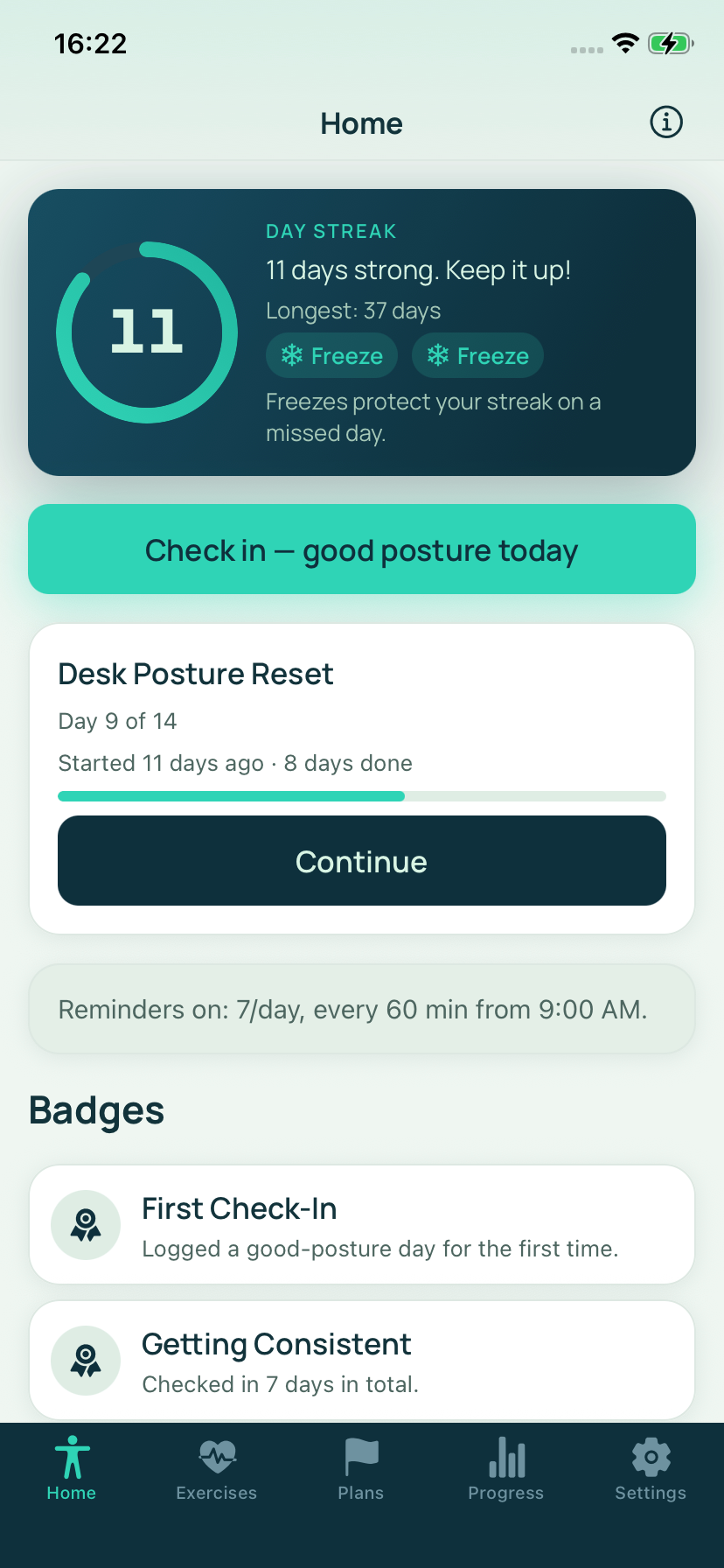
Demo check-ins and reminders · not a clinical result.
Move gently and skip anything that causes pain. See a professional if you have persistent pain.